Updated 10 June 2026
Good signage can strengthen your ability to impress. Reputation is central to a school’s success. Many factors influence where a student is enrolled, including examination results, educational outcomes, faculty quality, and the integrity of the student body.
In this article, we’ll explore how confusing navigation can quietly undermine a school's academic reputation and the balance required to align clear wayfinding with a prestigious brand identity.

The Problem with Poor School Signage
Efforts to build prominence through academics can be impacted by a lacklustre school environment, further compounded by poor signage that weakens leadership perception.
Incongruous signage can create confusing, chaotic experiences for visitors, first-time families, and prospective students. Conversely, good, well-designed signage that simplifies navigation through an unfamiliar site enhances the overall positive encounter.
Balancing Navigational Utility vs. Brand Identity Through Your School Signage
Developing and implementing a wayfinding strategy for the education sector can amount to a science. As a school, university, or higher education provider, your signage system may guide faculty and students throughout various areas of the school or campus.
Yet it may not be fully maximising opportunities to emphasise your prestige, leadership, and name. Alternatively, the aesthetic appeal of your signage could be costing you the ability to build your reputation.
Easing Campus Flow: The Dynamics of Movement
With proper maintenance planning that utilises expertise, you can have a signage solution that effectively augments the educational experience you offer, set against a backdrop that facilitates transitioning between classes. Students and teaching staff can navigate from one class to another with minimal disruption.
For example, lessons and lectures finishing at the same time are akin to peak-hour traffic. In the midst of students rushing to change classrooms or moving between lecture theatres, unclear signage adds to the day’s disorder.
Yet a strategic signage solution designed around comprehensive wayfinding and featuring easily grasped information can aid the unimpeded flow of traffic.
Benefits of Good School Signage
While the direct purpose of signage is to tell people where to go, a thoughtfully planned system delivers far deeper institutional advantages.
Beyond basic navigation, high-quality campus graphics quietly strengthen your school's cultural presence, reinforce leadership identity, unify a changing campus footprint, and project structural professionalism to everyone on-site.
Good signage is an unsung brand hero
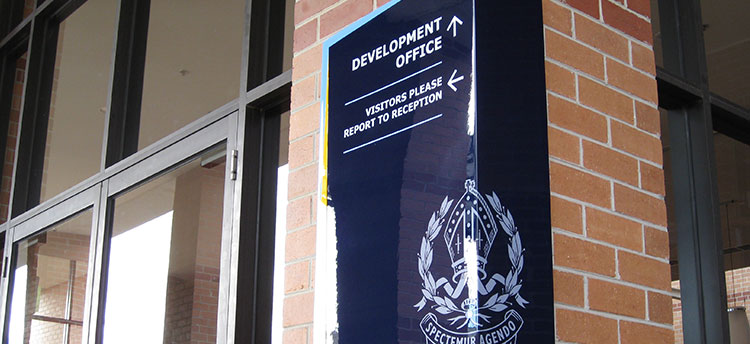
Well-designed signage implemented consistently helps portray a unified brand and image. Often, branding and signage in the education sector are located in external areas, where they can also reinforce leadership presence.
However, rather than restricting indoor signage solely to directional purposes, consider capitalising on the branding opportunities it offers your interior spaces.
Retaining the level of appeal and wayfinding principles inside buildings ensures the continuous resonance of your brand, prestige, and leadership across all areas.
Good signage builds consistency and congruency
Many schools and universities are composed of different structures, which may have been built at different periods or refurbished to accommodate more students. It may also include expansion across additional sites.
Often, such development can result in a lack of brand or image congruency. With expert guidance in signage design, brand cohesiveness across different sites and buildings can be implemented, regardless of location. This provides assurance that educational standards and leadership expectations are similar across sites.
Site-specific circumstances can also be considered where relevant to synchronise signage with the landscape or architecture.
Strengthen Your Campus Image Today
Your campus environment speaks volumes before a visitor ever steps into a classroom. Investing in premium, cohesive signage is a facility upgrade that can ultimately enhance your institution’s prestige, leadership image, safety, and daily operational efficiency.
How can you further your reputation through branding and signage that provides smooth navigation throughout your site while also enriching your prestige and leadership image in the eyes of the faculty, student body, and parents? Find out now with a chat to the experts at Programmed Commercial Painting today.