Updated 14 March 2026
Colour psychology is a well-established field, and its findings have practical applications for anyone responsible for a commercial interior. The colours chosen for a workspace, shopfront, or institution can influence how long customers stay, how well staff concentrate, and even how safe a space feels.
Understanding the basics before committing to a palette is far less costly than repainting after the fact.
Warm and Cool Colours
The colour spectrum is divided into two parts – warm and cool. Warm colours are hues at the red end of the spectrum, whereas cool colours are those towards the blue end.
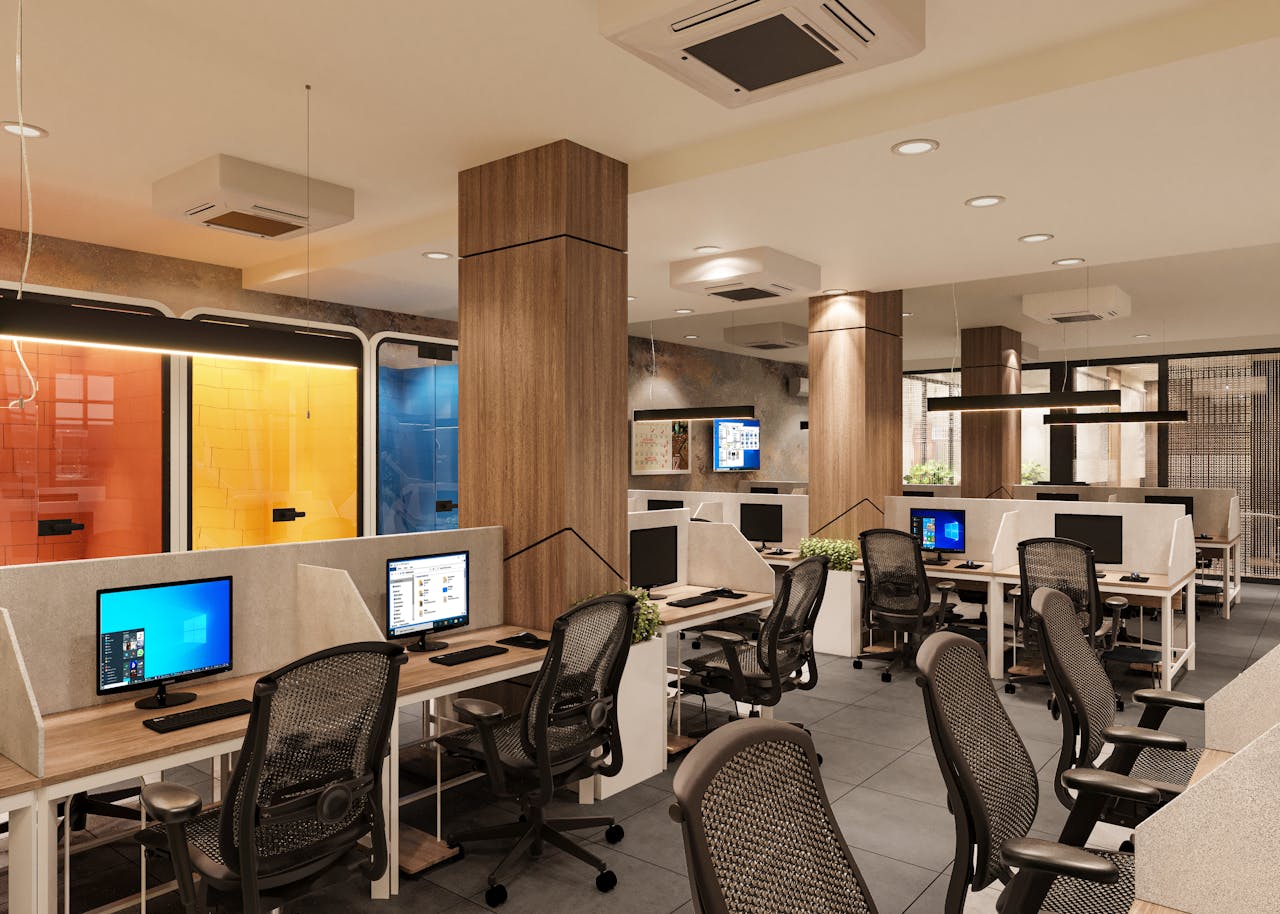
Generally speaking, warm colours encourage feelings of energy, happiness, and teamwork. Warm colours can also help spur on aggressive behaviour as well. However, cool colours can help to create a calm environment and aids in concentration.
A colour’s ‘temperature’ can also affect our perception of how warm or cold a room is. People in warm coloured rooms generally think the air temperature is higher than those in cool coloured areas. This is something to bear in mind if you’re looking to control electricity costs.
What Colours Can Mean in Interior Design
The colour wheel organises hues to simplify their application in commercial design, helping designers achieve harmony or contrast. Beyond these relationships, individual colours carry psychological associations, often rooted in nature and culture, that directly influence how people feel and behave within a space.
Blue
Blue is considered the most productive colour and people working in blue rooms generally work more efficiently than those in coloured rooms. Due to its productive capabilities, blue is a good colour to use in office areas and sites where a high output is required, such as in manufacturing.
Green
Often associated with nature and growth, green is recognised to promote a sense of balance. Green has relaxing qualities so it’s ideal in situations where possible tension or nerves need to be diffused. It can be effective in break rooms to promote relaxation, or combined with blue to create a stress-free productive space.
Green not only creates a relaxing environment, it’s also commonly used in promotion to evoke a sense of calmness as well. For example green or more specifically, a soft green is often associated with day spas. The notion of relaxation is central to this industry’s service offering and is often reflected in its branding.
White
White evokes a sense of space and light. It’s often associated with modernity and has been successfully used in store design for technology brands, such as Apple and Sony.
However, the use of too much white can make spaces a little flat and dull. People within these spaces can become bored and want to leave, which isn’t ideal if your goal is productivity or sales.
Red
Red is an emotionally charged colour. It helps to increase people’s heartbeats and the reaction time of their responses, while at the same time reduces the ability for analytical thinking.
As mentioned in the first sentence of this article, it probably isn’t the best colour for the boardroom where productive and collaborative discussion is required.
This is not to say that red doesn’t encourage productivity, it does, but the physical kind. This may be the reason why many gyms include a strong red in their branding.
Yellow
Yellow is an optimistic colour, but it’s also intense and should be used sparingly. As with red, too much yellow can also encourage aggression.
Intensity of Colour
Beyond the choice of colour itself, intensity plays a significant role in how people respond to a space.
Angela Wright, a recognised colour psychologist, has found that strong, saturated colours tend to stimulate people, while lighter, more muted tones create a calming and relaxing atmosphere. A bold cobalt blue and a soft powder blue may share the same hue, but they produce very different results in practice.
When specifying colours for a commercial interior, intensity deserves the same attention as the colour selection itself.
Find the Right Colour for Your Commercial Space
Choosing colours for a commercial space involves more than preference. It involves understanding how a space will be used, who will occupy it, and what behaviour you want to encourage. Getting that balance right from the start means fewer costly repaints and a fit-out that performs as well as it looks.
At Programmed Commercial Painting, we have been working with commercial clients across Australia since 1951. With over 32,000 people employed each year and partnerships with more than 10,000 customers across industries, we bring both the technical expertise and the industry understanding to help you make the right call.
Whether you’re refurbishing a single floor or repainting an entire facility, we can help you move from colour decision to finished result with confidence. Contact Programmed Commercial Painting to discuss your next project.
If you want to see how a new productive colour scheme will look in your facility, try Dulux’s My Colour app.