Updated 11 June 2026
The welcoming, relaxed outdoors is perfect for learning that extends beyond classroom walls.
Schools can take education outside by turning unutilised or vacant areas of the school yard into interactive landscapes, gardens and outdoor areas.
Such themed gardens or play areas built with natural wood, rocks, and plants bring lessons to life, inviting creativity as young people engage with each other and nature.
What is an Outdoor Learning Environment?
An outdoor learning environment is a modern school trend that involves purposefully designing an external space that supports a student’s academic, social, and emotional development.
Unlike a standard recreational playground, these areas integrate natural elements such as native flora, pathways, water features, and raw building materials to serve as extension classrooms where curriculum concepts are taught in a practical, real-world context.
Facilitating outdoor learning allows schools to provide students with a sensory-rich environment that accommodates various learning styles. With this approach, learning can begin even before such spaces are constructed.
“Inviting students to workshop and conceptualise the form and function of such areas challenges them while giving them ownership and belonging.“
- Martin Crabb, specialist horticulturist and landscape designer at Programmed Property Services (2016)
And as the project progresses, lessons in planning, tolerance, and understanding of conflict are also imparted. Such skills last a lifetime.
Examples of Schools in South Australia that Implemented Outdoor Learning
Three schools in South Australia recently took learning outside with very successful, albeit different, outcomes.
St John the Baptist Catholic School
St John the Baptist Catholic School in Plympton melded learning with gardening through a biblically-themed garden featuring plants students learn about in Bible studies. Students were involved in choosing plants and entrusted with the garden’s design.
Subsequently, cuttings from these very plants and gardens were brought inside and included in lessons. The strong connection to the subject matter and the fluid continuity, taking students from inside classrooms to creation outside, made for wonderful, unforgettable learning.
The school also planted an edible kitchen garden. Their next generation of gardeners was excited to get their hands dirty in planting as well as in reaping (and eating) what they sowed. The project drew out innate qualities as students of even very young ages showed passion and learnt how to share responsibilities.
Students embraced their culture through herbs and vegetables unique to ethnic dishes, but also identified with one another through those common across different cuisines.
“It was wonderful to celebrate both the diversity and the unity of the students. Who would have thought a garden could do that!”
- Angela De Nadai, the St John the Baptist Catholic School’s Assistant Principal and Religious Identity and Mission (2016)
St Mary Magdalene’s School
For St Mary Magdalene’s School, its Aboriginal-themed garden provided a living link to Aboriginal culture.
“The garden has been a real feature of the school and something the community is immensely proud of. Students love to talk about and share it.”
- Dan Cowan, Acting Principal, St Mary Magdalene's School (2016)
Local indigenous plants, natural elements, and student artwork reflecting the garden’s theme combined to create interesting focal points. Reference codes along the walking path explain the symbolism behind the art and the choice of colours.
The plants, chosen for their traditional use as food, medicine, tools and even shelter, make lessons come alive. Unsurprisingly, Rhagodia spinescens, whose fruit is used for red face paint, is a perennial conversation starter.
Seaford’s All Saints Catholic Primary School
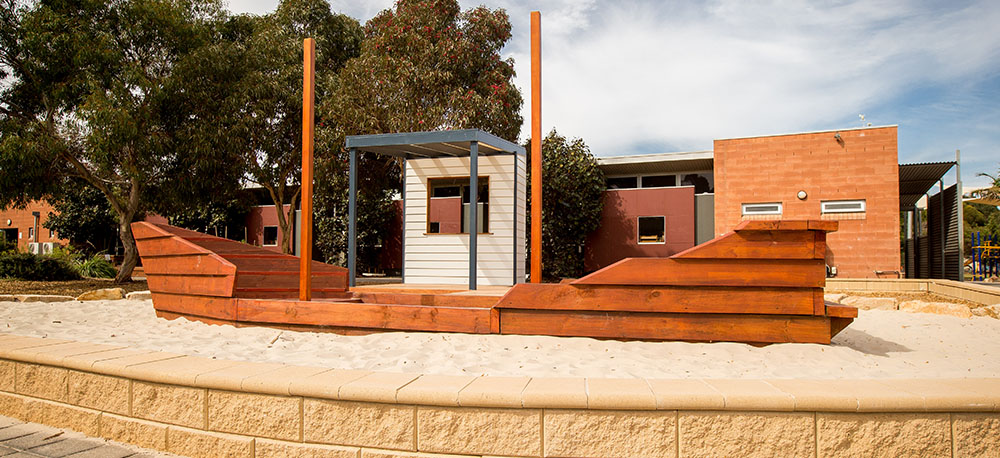
Meanwhile, a maritime-inspired playscape reflects the seaside location of Seaford’s All Saints Catholic Primary School. The showcase boat and shop front have transformed a previously unutilised school yard area into an area for playing and learning, which school principal Justin Cavuoto describes as ‘much loved’.
Create a Conducive Outside Learning Environment with Programmed
Taking learning outside through gardens and landscaped areas encourages the unfettered imaginings of the young and the not-so-young alike. As a result, such spaces, be they gardens or play areas, are extremely multifunctional, equally suitable for encouraging role-play as for assemblies or welcoming new families.
The myriad combinations of elements, plants, structure and colour allow schools to create gardens as distinctive as themselves. All it takes is inspiration and a small patch of ground. Is there one at your school?
If so, and you would like to transform it into something that allows students to investigate and learn interactively, contact Programmed Property Services for a solution tailored to you.